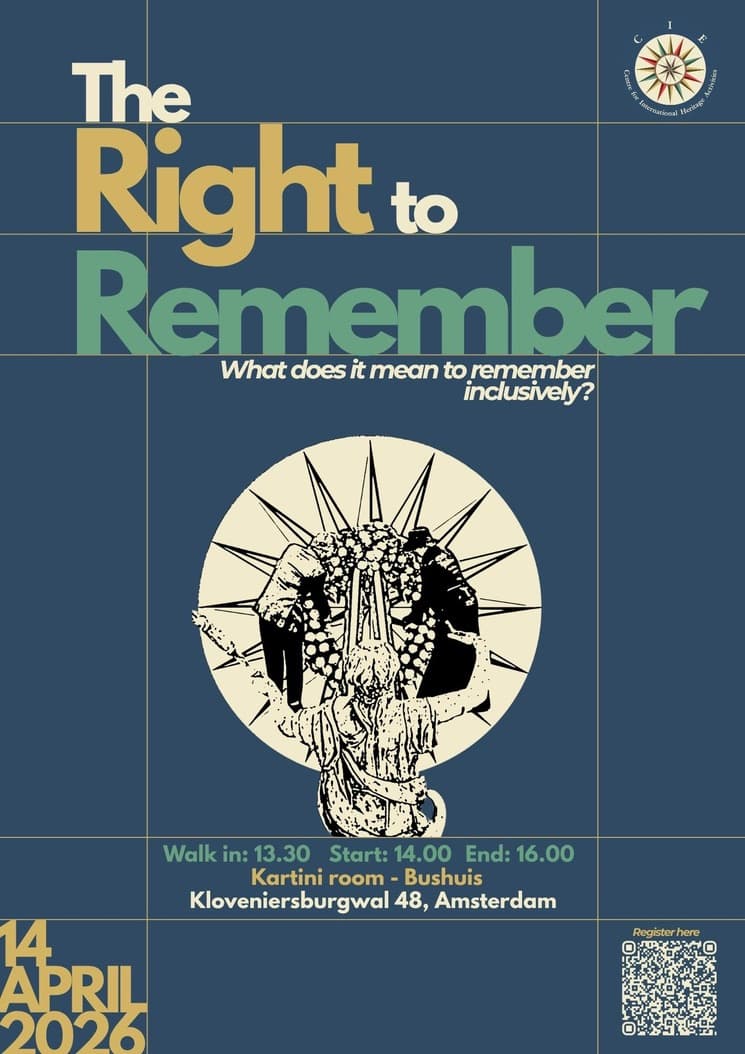
Poster for The Right to Remember seminar in Amsterdam on 14 April 2026
Amsterdam seminar · 14 April 2026

International seminar & research series

The Right to Remember

What does it mean to remember inclusively—and who has the authority to decide how and whom we remember?

Memory & powerPublic dialogueActive

The programme

Memory is never neutral.

The Right to Remember is an international seminar and research series exploring how memory, power and heritage shape one another. It brings researchers, practitioners, artists and communities together to examine commemorations, monuments, museums and archives—and to ask whose histories they make visible.

Public remembrance can support recognition and repair, but it can also reproduce a dominant narrative and leave other experiences unheard. The programme creates space for alternative commemorations, contested memories and difficult conversations about colonial histories and historical injustice.
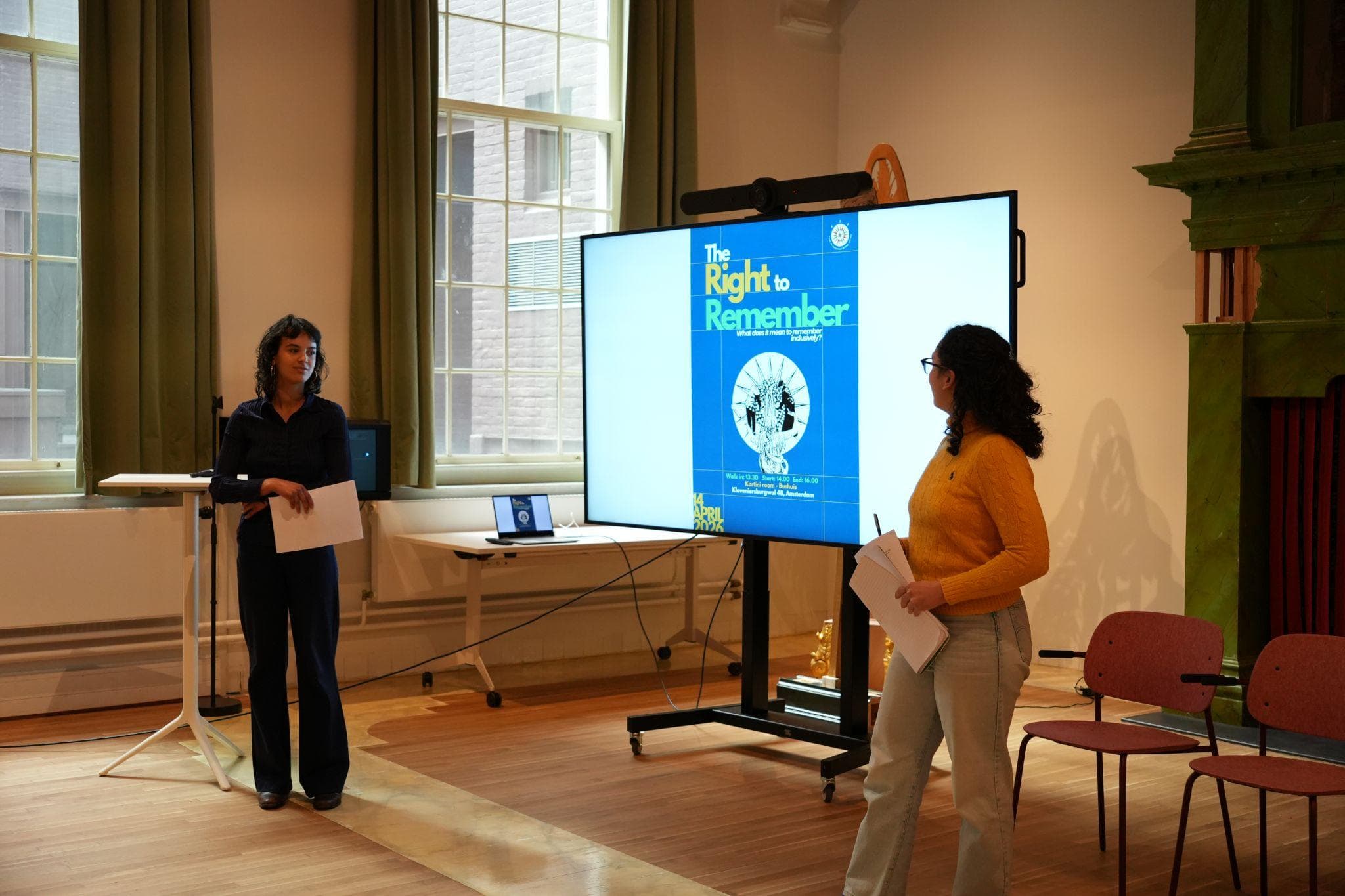
Ava Abtahi and Carlijn Smits opening The Right to Remember seminar in the Kartini room
CIE event documentation · Kartini room, Amsterdam · 14 April 2026

Amsterdam · 14 April 2026

A room with a changed name.

The first seminar took place in the University of Amsterdam’s Kartini room. Until 2023, the space was known as the VOC room. Its renaming and reframing made it a particularly resonant setting for a conversation about colonial memory, decoloniality, race, inclusion and social justice.

Organised by Ava Abtahi and Carlijn Smits, the event connected Moluccan history, national and alternative commemorations, public apologies and the rehabilitation of people harmed by colonial rule.

Questions at the centre

Four routes into inclusive memory.

The series starts with questions rather than fixed answers, keeping authority, context and lived experience in view.

  1. 01Who has the authority to decide how and whom we remember?
  2. 02What makes remembrance genuinely inclusive?
  3. 03How do colonial histories shape today’s public memory?
  4. 04When do apologies and rehabilitation become meaningful forms of repair?

The Amsterdam seminar

Four perspectives,
one shared dialogue

The contributions moved from commemoration to apology and rehabilitation, then brought these themes together in an open discussion.

History & heritage01

Wim Manuhutu

Historian and heritage professional specialising in Indonesian history; lecturer in political history at Vrije Universiteit Amsterdam.

Whose Right to Remember?
A critical reading of simplified narratives about Moluccan history and presence in the Netherlands.

Read speaker report ↓
Author & heritage practitioner02

Umayya Abu-Hanna

Palestinian author and CIE project coordinator working across memory, identity, cultural practice and public dialogue.

“Never Again”: An Empty Promise?
On alternative commemoration and the responsibility to remember victims beyond national boundaries.

Read speaker report ↓
Memory studies03

Gerlov van Engelenhoven

Assistant professor at Leiden University Centre for the Arts in Society, specialising in postcolonial memory and heritage.

Public Apologies as Memory Work?
Who apologises, for what, and whether an apology can be meaningful without consequences.

Read speaker report ↓
Policy & music04

Jerry Gumbs

Policymaker at the Ministry of Climate Policy and Green Growth and socially engaged rapper, performing as Juny Martina.

Rehabilitation: Symbolic or Effective?
Reflecting on Tula and Medardo de Marchena, and on what rehabilitation means when colonial structures persist.

Read speaker report ↓

Discussion and outcomes

From recognition to responsibility.

The discussion brought commemoration, public apology and rehabilitation into the same frame. Participants repeatedly returned to the power behind acts of remembrance: who defines the story, who is addressed, who benefits and what changes after recognition has been offered.

The audience questioned whether a public apology can be valid without consequences and whether rehabilitation remains symbolic when the structures that produced historical injustice are left intact. At the same time, the seminar showed how alternative commemorations can make room for agency, resistance and solidarity across different histories.

Rather than seeking one shared version of the past, the dialogue emphasised the need to examine how histories are written, how communities are represented and how people can retain authority over their own memories.

01

Question authority

Every public narrative reflects choices about whose knowledge counts and whose histories remain outside the frame.

02

Make room for complexity

Inclusive memory resists simplified binaries and recognises differences within communities as well as between them.

03

Connect words to change

Apology and rehabilitation gain meaning when they acknowledge continuing power structures and lead to consequences.

04

Let the concept travel

The cases were rooted in the Netherlands, but the relationship between memory, identity and power crosses places and generations.

Speaker reports

Four contributions
in more detail

These summaries draw together the biographical context, central argument and discussion prompted by each presentation.

01

History & heritage

Wim
Manuhutu

Back to speakers ↑

Whose Right to Remember?

Bio. Wim Manuhutu is a historian and heritage professional specialising in the history of Indonesia and a lecturer in political history at Vrije Universiteit Amsterdam.

Manuhutu began by turning the seminar title into a question: whose right to remember is being discussed? He examined the familiar account that places the beginning of Moluccan presence in the Netherlands in 1951, when the first ship carrying Moluccan families arrived.

While 1951 is central to public memory, he argued that the dominant story is incomplete. Moluccan connections with the Netherlands reach back to the seventeenth century, and the usual Dutch–Moluccan binary can flatten a diverse community into a single category. His contribution called for closer attention to terminology, complexity and the power involved in writing history.

02

Author & heritage practitioner

Umayya
Abu-Hanna

Back to speakers ↑

“Never Again”: An Empty Promise?

Bio. Umayya Abu-Hanna is a Palestinian author and CIE project coordinator whose work connects memory, identity, cultural practice and public dialogue.

Abu-Hanna reflected on the alternative commemoration held outside the Anne Frank House on 3 May 2024. Organised as a wake for Holocaust and Palestinian victims, it sought to create a space where different histories of suffering could be remembered together.

Her contribution asked what happens when people do not recognise themselves in a national commemoration or feel unable to express solidarity within it. She described the alternative gathering as a practice of love and intersectional solidarity, and argued that the right to remember is inseparable from the right to retain and express one’s identity.

03

Postcolonial memory

Gerlov van
Engelenhoven

Back to speakers ↑

Public Apologies as Memory Work?

Bio. Gerlov van Engelenhoven is an assistant professor at Leiden University Centre for the Arts in Society, specialising in postcolonial memory and heritage.

Van Engelenhoven approached public apology through the history of the Moluccan community in the Netherlands. Rather than prescribing an answer, he opened a series of questions: what should an apology address, who should offer it, why should it happen now and what purpose should it serve?

Leaving these questions open invited the audience to examine the power dynamics of apology. The discussion focused particularly on who benefits—the people receiving an apology or the institution making it—and whether an apology without material or political consequences can constitute meaningful memory work.

04

Policy, performance & critique

Jerry
Gumbs

Back to speakers ↑

Rehabilitation: Symbolic or Effective?

Bio. Jerry Gumbs is a policymaker at the Ministry of Climate Policy and Green Growth and a rapper known as Juny Martina, addressing social and historical issues including colonialism.

Gumbs discussed the rehabilitation of Curaçaoan figures Tula and Medardo de Marchena. His central question was whether rehabilitation can become meaningful while colonial structures continue to shape contemporary politics and public life.

A colour-vision exercise made the point tangible. After pretending not to see the numbers visible to the audience, he apologised for dismissing their perspective. The experiment presented rehabilitation as a change in how the world is seen: without recognising the structures that made injustice possible, it risks remaining a symbolic gesture.

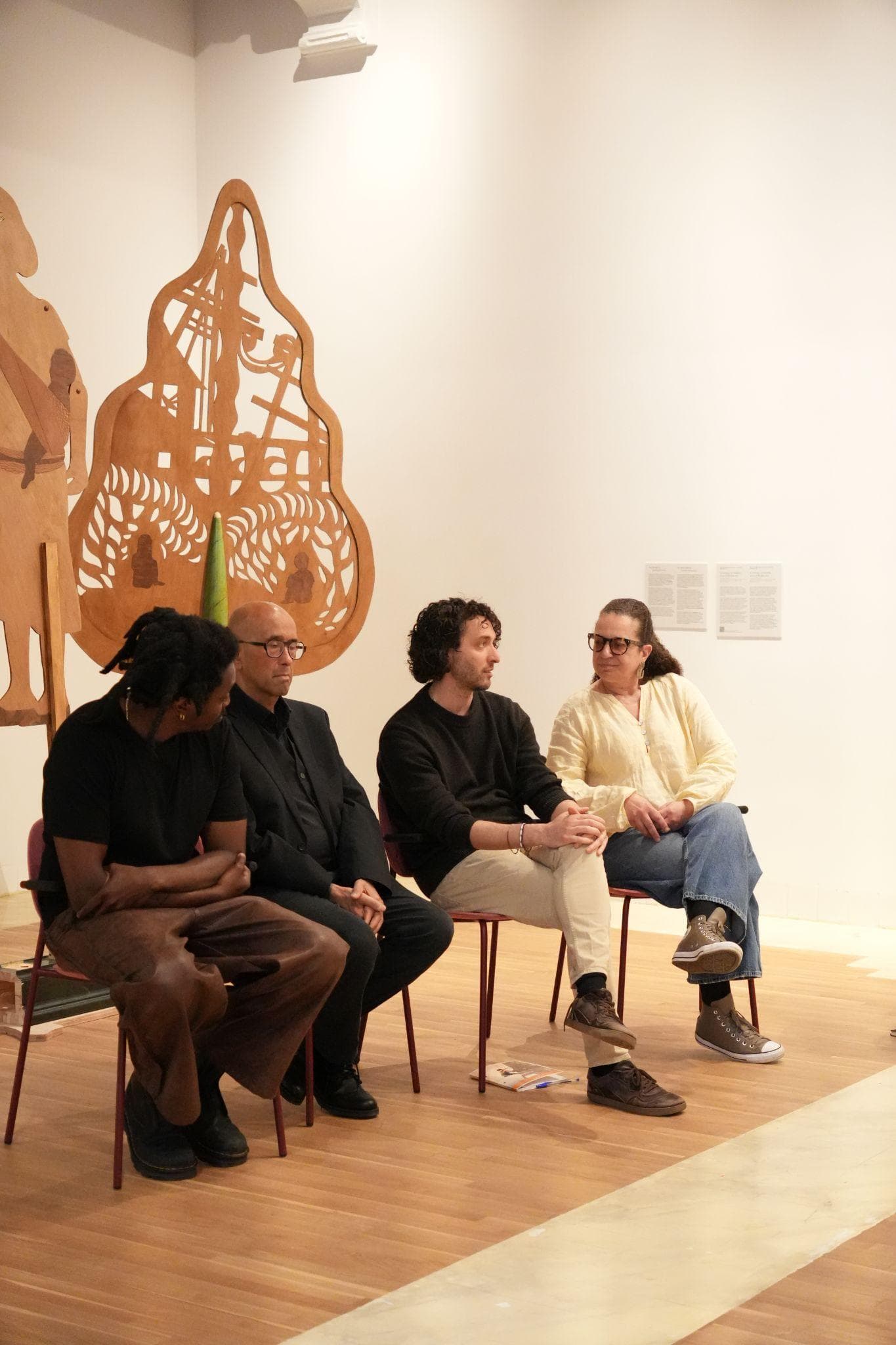
The four speakers in conversation during The Right to Remember seminar The speakers in dialogue · CIE event documentation

A travelling concept

The conversation continues beyond one room.

The concluding dialogue brought the four cases into conversation and showed the value of personal, academic, artistic and professional perspectives meeting in one room. The audience’s readiness to respond confirmed the importance of making contested memory discussable in public.

The right to remember can travel across places and generations, connecting public history to identity, dignity and the possibility of repair. Future seminars will extend the conversation with new voices, contexts and forms of exchange.

Follow upcoming events ↗

Bring a memory, question or case into the dialogue.

Connect
with CIE